
Hello again and welcome to the (belated) fourth volume of Backyard Botanist! We are gathered here today to learn all about a plant called Amaranth (Amaranthus). But first, I have to tell you a funny (not really) story.
So, I bought a blueberry bush sapling from the store and brought it home. My thought process was, "Cool. We'll have a little blueberry bush, and I can show my kids the stages of growth until they can finally pick and eat their own blueberries". I plant said sapling in a large pot, see that it's in proper conditions and I go on with my life. Yeah, that twig of a bush just shriveled up like a raisin. In hindsight, the plant was probably on deaths door when I bought it. In any event, I placed the potted (deceased) plant on the back porch until I had something else to occupy the pot. A week or so later, I had some Devil's Ivy cuttings (Pathos) that were ready to be planted. Thinking that the earlier mentioned pot would be a great candidate for the cuttings, I stepped out the back door and this is what I find... 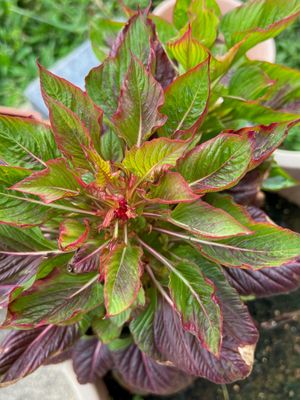
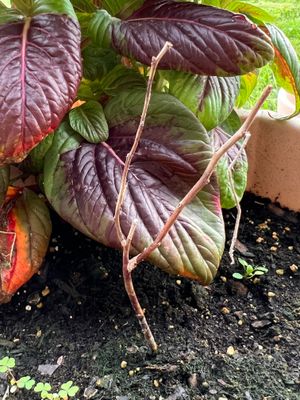
Amaranth. In all its growing glory. Knowing well that I did not plant any Amaranth in this pot, I chalked it up to a prime example of seed dispersal via local fauna (wildlife)...The End. Thanks nature.
I digress.
 This tall, upright growing, annual plant loves hot and humid summers. It can take around 40-50 days to mature. There are well over 60 known varieties, and you can find them in many parts of the world. From tropical lowlands to the Himalayas, this stuff is virtually everywhere. I wanted to throw a little history into this segment and a bit of cultural application. Here goes. Amaranth is considered one of the Ancient Grains. In pre-Hispanic times, amaranth was cultivated by the Aztec people similarly to maize. Known to the Aztecs as huāuhtli, amaranth is thought to have represented up to 80% of their food consumption before the Spanish conquest. The cultivation of amaranth was outlawed shortly after the conquest. Another important use of amaranth throughout Mesoamerica was in ritual drinks and foods. Still today, amaranth grains are toasted much like popcorn and mixed with honey, molasses, or chocolate to make a treat called alegría, which means "joy" in Spanish. I haven't cooked it this way yet, but Fall is right around the corner. In Brazil, green amaranth was, and to a small degree still is, often considered an invasive species. Though many have traditionally appreciated it as a leaf vegetable, by the names of caruru or bredo, which is consumed cooked, generally accompanying the staple foods of that culture. Several species are raised for amaranth "grain" in Asia and the Americas. Amaranth and its relative, quinoa, are considered pseudocereals because of their similarities to cereals in flavor and cooking. Let's move on and learn how to identify this stuff. Shall we?
Flower: In reality, Amaranth flowers are tiny spikes of red purple or yellow flowers depending  on the species. The tiny flowers have prickly petals and bracts forming dense, ornate clusters
that form at the ends of stems. They can appear as huge tassels, upright branches,
even tiny globes, depending on the plant variant. As such, these tiny clusters of flowers
result in tiny clusters of seeds.
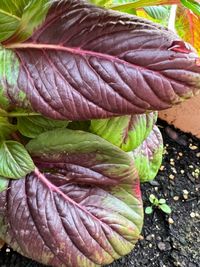
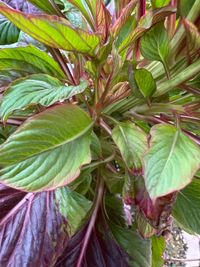
Leaves: The leaves of the Amaranthus are broad and oval in shape with pointed tips and are around 2.5 to 6 inches (6.5-15 cm). They come in green, red, or a mixture of colors and can be smooth or covered in tiny hairs growing alternate or opposite depending on the species. (Pictured: left, mature leaves/right, young leaves)
Edible parts of this plant include the leaves, seeds, stems, and roots. It's a great plant all around. Nutritious and easy on the eyes.
Medicinal Uses: Can reduce cholesterol levels if eaten daily. It has rich content of dietary minerals such as calcium, magnesium, phosphorus, and potassium. One cup of raw amaranth contains 28 grams of protein, 15 milligrams of iron, and 18 milligrams of fiber, which makes it one of the most nutrient-rich grains on earth.
How To Harvest and Eat: The greens and seeds are best eaten cooked. Young leaves can be plucked in early Spring and served raw in salads. Mature leaves taste similar to spinach but with a rougher texture. I suggest harvesting them early in the day and plunged into ice cold salted water for 15 minutes or so. The seeds (my favorite part, honestly) are tiny, close to the size of sesame seeds, and have a sweet nutty flavor. They're really easy to harvest as well. Simply shake the seeds off the plant into a bowl. It's easy to cook, too. Boil seeds with twice the amount of water as grain by volume (or 2.4 times as much water by weight). Amaranth seed can also be popped one tablespoon at a time in a hot pan without oil, shaken every few seconds to avoid burning.
And now, on to the recipe!
Amaranth Pilaf
 Ingredients:
2 cups amaranth leaves (trimmed and washed)
1 cup amaranth seeds
1 medium sized sweet onion (finely diced) or a handful of shallots
1 large garlic clove (peeled and finely diced)
cooking oil such (I like grapeseed oil)
desired seasoning
However, I will suggest using an Herbs des Provence blend as it typically contains fennel, marjoram, lavender, savory, mint, rosemary, sage and thyme. It's tasty. Trust me.
Warm one small pot for the pilaf, one small skillet for toasting amaranth seeds, one medium skillet for toasting amaranth leaves, and heat the cooking oil. place some onion and garlic in each and sauté for around five minutes. Turn off the small and medium skillet for now. In the small pot, add one cup of amaranth seeds and toast them in the oil, onion, and garlic for 3-5 minutes. Now, add 3 cups of water, stir, place a well-fitted lid, and reduce heat to low for 25 minutes. After 25 minutes have passed, let this stand with the lid remaining on for an additional 15 minutes. Re-heat the medium skillet and sear the amaranth leaves in onion and garlic. Then, re-heat the small skillet and toast the remaining amaranth seeds with onion and garlic. 
You are ready to enjoy your pilaf! Serve with seared leaves and toasted seeds for an amazingly flavorful texture. I've found that this dish can
work as a great main dish for lunch or an eclectic side at dinner.
I hope you've enjoyed this volume of Backyard Botanist! Until next time!